From the 1930s until 1965, pack donkeys — originally shipped from Roswell, New Mexico — supplemented the hut and construction crews. Said Joe Dodge of the early days of mule-packing, "The real problems with the donks began when [you] tried to get them to do something." Dodge hired a muleskinner who soon had the donkeys hauling like pros — when they weren't being mistaken for deer by city folk and shotat. This "White Mountain Jackass Company" once landed six tons of supplies at Madison in one week. Today, helicopters have replaced the donkey trains, flying in food staples and materials to the huts twice each season.
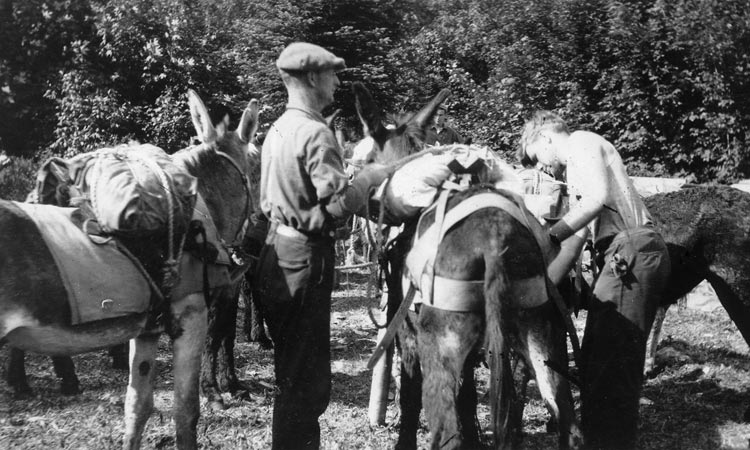
(The donkeys)... were the transport which got the huts equipped: the blankets, any new or replacement equipment, fuel for cooking, basic foods (almost always in cans). In the late '20's some thirty donkeys were shipped from New Mexico and quartered at the foot of the Greenleaf trail. Joe Dodge had rounded up a former mule — skinner in a remote Maine village to start the process. But by my time he had been replaced by sturdy New Hampshire men such as "Neighbor" George Harris and his brother Winnie. In winter the donks lived on the Harris farm in Whitefield.
Photo by Ray Cotnoir
May and June were critical months for the donks and the huts. My image is of a string of those durable animals on a steamy day churning up a muddy stretch of the Valley Way, surrounded by a swarm of mosquitoes and black flies led, by a couple of swearing sweating honchos as skinners. We didn't envy either man or beast. My other image of the donks is second hand from a later generation. It pictures the donks, under the banner of the WHITE MOUNTAIN JACKASS COMPANY and guided by some scruffy looking hutmen, occupying a centerpiece position in Gorham's annual 4th of July parade.
— Courtesy of Nick Howe
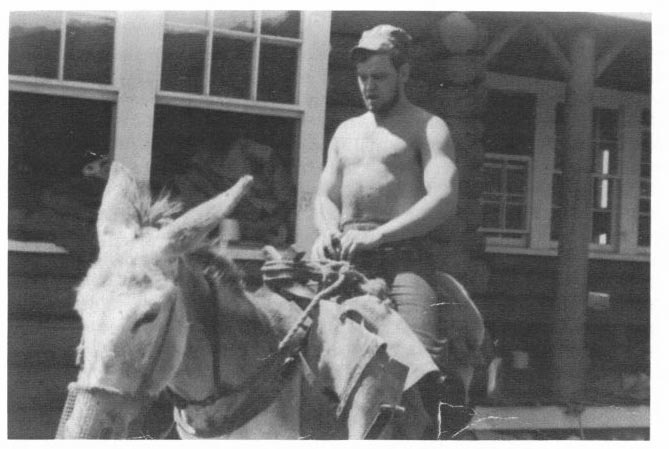
Photo courtesy of Appalachia Journal
"Muleskinner was the best job I ever had. Hell, you were out there by the corral in a big tent. Everything smelled like the mules. Your shoes smelled like the mules, your hair smelled like the mules, everything smelled like the mules all the time. It had to be, We always had good days. You started early and loaded up the mules while your breakfast was cooking. Then you started up the trail. Three, four or five hours on the trail, depending. Then you unloaded and came down and you were finished for the day. There were usually no people on the trails because it was early before the huts had opened."
— Edward Damp, "Of Mules, Mice and Madison." Appalachia, December 1980.

Photo courtesy of Dave Govatski
"Joe had finished Greenleaf Hut in 1930. That was the first year he used jackasses, the four legged variety, to haul construction supplies up to the huts. The White Mountain Packing Company had its origin in a weak moment of man packing, when several hutmen had enough of grunting the building materials, basic summer foods, blankets, fuel, and fixtures up the hillsides. Madison was the worst of all, and the inspiration for the jackass company came from crew members who had long experience at the "Madhouse." At this time jackasses were not part of our agenda, but I was going to hear a lot about them later on. Dick Abbot and Ralph Batchelder had bankrolled the deal, buying the burros and leading out their services to the club, although that got all changed pretty soon. It seems that Dick had gone to New Mexico and bought a string of forty animals, but when they arrived at Randolph, there were forty-one. "The god-damned railroad company had a helluva time getting their paperwork straight on that," said Joe. "They just couldn't account for a blessed event occurring in transit."

Photo by Ray Cotnoir
"The real problem with the donks began when they tried to get them to do something. Those two guys had a good idea, but they sure didn't know how to make those donks perform. They figured all you gotta do is load 'em up and whisper in their ear, "Go on up to Madison Hut," and everything would be okay. Well, when we started 'em packing in 1929, they were on the job for two weeks and only landed six hundred pounds at the Madhouse. Hell, I could have had two guys walking backwards deliver twice as much in half the time... We got Cleo Smith [from Fryeburg] on the job, then things really began to happen. In one week we landed six tons of supplies up there; long boards, sheets of Celotex, fuel oil, everything. That guy was a real packer.
"Of course, we had some trouble with those critters, too, but the most important thing we did was to get an experienced mule skinner to train some of our boys proper. After that, the donks did pretty well on their own. We did have a few troubles, like the time a few years later, when one old white donk from the original string got edged right off the trail and fell down into King Ravine. She was stone dead, so neighbor George Harris climbed down and carried her load back up to the trail, even the saddle; then he covered the old girl with some branches for a grave."
— Joe Dodge by Bill Putnam
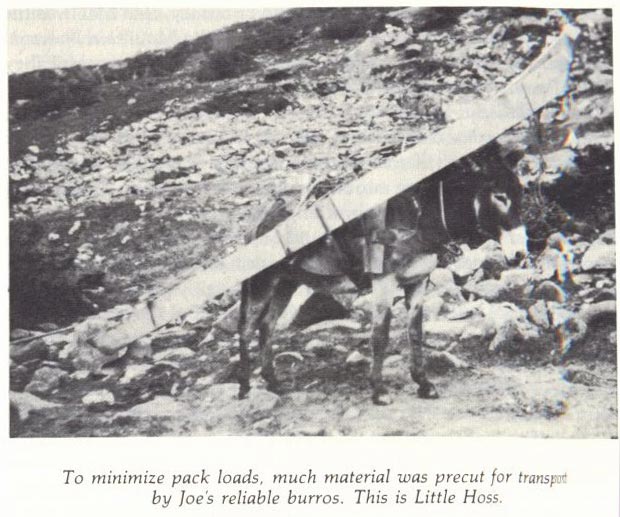
Photo courtesy of Joe Dodge by William Lowell Putnam